
· by Michael Blair, Nashville's Mobile Detailing
Swirl marks are fine, shallow scratches in the clear coat, the kind coating researchers call mars. NIST’s account of its 2018 clear coat scratch research quotes physicist Li Piin Sung saying those shallow, hard-to-see marks are most often the result of car washing, while the bigger, deeper scratches from keys, tree branches and shopping carts are what NIST calls fracture scratches, a separate kind of damage. Taking swirls back out means machine polishing the clear coat, which is paint correction, so the cheaper fix is a wash that doesn’t put them there.
How does the two-bucket method work?
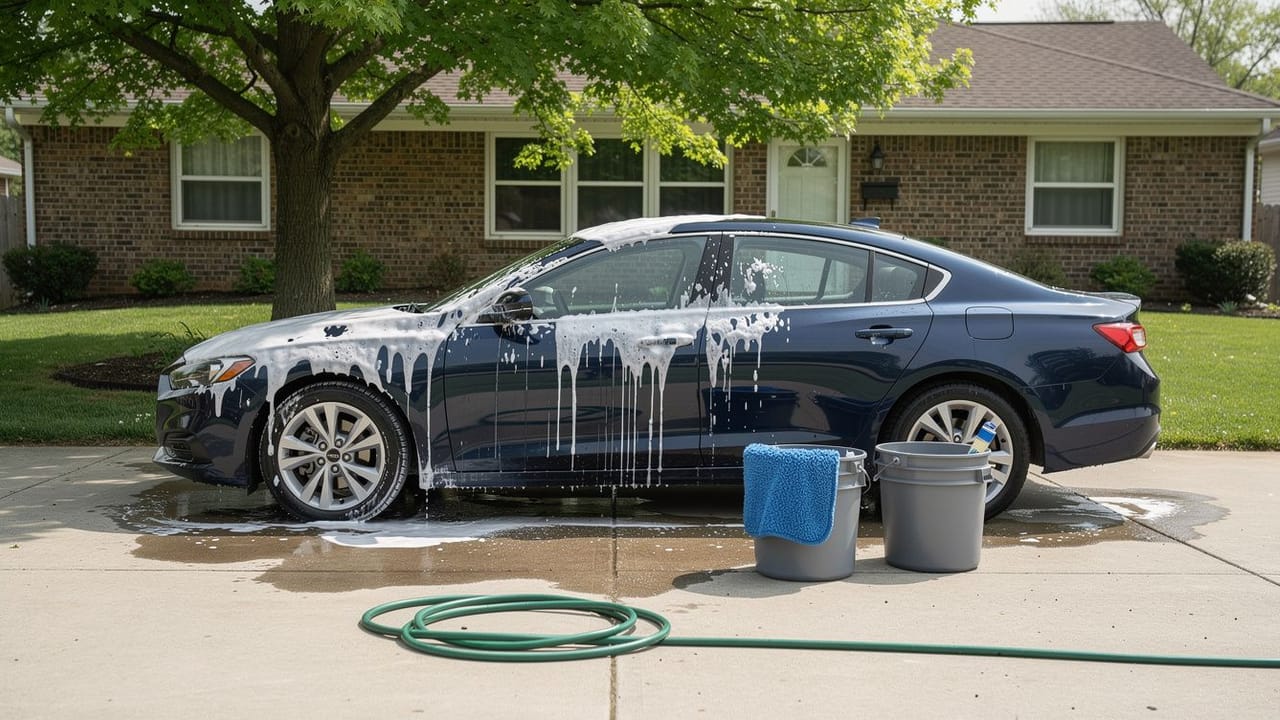
We wash from two buckets, one of soapy water and one of plain rinse water, with a grit guard sitting in the bottom of each. After every panel the mitt goes into the rinse bucket first, so the dirt it picked up settles there before the mitt goes back into the soap.
Grit is the reason. When coating makers test how a clear coat survives washing, the standard car-wash test described in the NIST and industry paper on clear coat scratch resistance runs a spinning polyethylene brush over a painted panel while spraying water with fine quartz in it to simulate dirt, then measures how much gloss the panel lost. Wash from a single bucket and whatever you rinse off the mitt stays in the water you reload it from.
Rinse thoroughly first
Before a mitt touches the car, we rinse it from the roof down to flush off loose grit, and on a dirty car we foam it and let that sit before rinsing again. Whatever comes off with water alone is grit the mitt never has to drag across the paint.
Then we wash from the top down, because the lower panels are usually the dirtiest and we’d rather the mitt reach them last. It’s the same order we follow on every exterior detail.
- Two buckets with grit guards
- Pre-rinse and ideally pre-foam
- Wash top down, rinse the mitt every panel
- Dry with a plush microfiber or a blower, never a chamois drag
- Avoid brush automatic washes entirely
Drying can undo a careful wash
A towel dragged across wet paint can pull along any grit the rinse missed. We blow most of the water off and touch the paint as little as possible, then lay a large, plush microfiber towel flat on whatever is left and blot it.
A light mist of drying aid on each panel first gives the towel some slip. We dry a coated car exactly the same way, and our post on whether a ceramic coating is worth it explains why a coating is no excuse for a careless wash.
Do automatic car washes scratch paint?
Brush washes can mar clear coat, and coating makers test for exactly that: NIST describes one of the industry’s two standard scratch tests as a rotating wheel of brushes that simulates the impact of car washes on clear coats. That’s why we’d skip brush washes entirely.
Touchless washes keep brushes off the paint and lean on chemistry instead. Zep’s specification sheet for its touch-free car and truck detergent describes an alkaline detergent with a concentrate pH of 12.5 to 13.0, and warns that above 70°F paint damage is possible if it sits too long or dries without a proper rinse. We haven’t seen a test of what that chemistry does to wax or sealant, so we wouldn’t make a habit of it.
In winter we think an occasional touchless wash is a fair trade for getting road brine off the car, which our post on road brine and winter car care goes into. For a hand wash that leaves the paint the way it found it, ask us for a free quote.
Sources
- NIST, To Improve Auto Coatings, New Tests Do More Than Scratch the Surface (2018) — Shallow mars are most often the result of car washing; fracture scratches come from keys, branches and shopping carts; the Amtech-Kistler brush wheel simulates car washes on clear coats
- Feng et al., Fundamentals and characterizations of scratch resistance on automotive clearcoats, Progress in Organic Coatings (2018) — The Amtec-Kistler car-wash test (ISO 20566): a rotating polyethylene brush drum with a quartz-in-water spray simulating dirt, scored by gloss loss; many mars close together become obvious
- Zep Inc., Product Specification Report #8042, Car & Truck Touch-Free Detergent — Alkaline touch-free detergent, concentrate pH 12.5 to 13.0; paint damage possible above 70°F with excess contact time or drying without a proper rinse
FAQ
Washing a Car Without Putting Swirls In — questions
What causes swirl marks?
They are fine, shallow scratches in the clear coat, and NIST researchers say marks of that kind most often come from car washing. In a home wash the usual culprit is grit dragged across the paint by a dirty mitt or towel, and in an automatic wash it is the brushes. One mark on its own is hard to see; it is many close together that become obvious.
Are touchless car washes safe for paint?
Nothing touches the paint, so they avoid the brush marring the industry’s car-wash test is built to reproduce. They rely on strong detergent instead, and one maker’s touch-free detergent warns that above 70°F paint damage is possible if it sits too long or dries before it is rinsed. We would use one now and then, in winter especially, and stay away from brush washes.
What is the best way to dry a car?
With a blower, touching the paint as little as possible, or with a large, plush microfiber towel laid on the paint and blotted rather than dragged. We mist on a drying aid first so the towel glides. We don’t use a chamois, because it gets pulled flat across the paint along with anything the rinse left behind.
Do automatic car washes scratch your car?
Brush washes can. One of the industry’s two standard scratch tests, as NIST describes it, uses a rotating wheel of brushes to simulate the marring car washes do to clear coat, which is why we avoid them entirely. Touchless washes keep brushes off the paint but rely on strong alkaline detergent instead.