
· by Michael Blair, Nashville's Mobile Detailing
Interior detailing in Middle Tennessee comes with a factor that drier places see less of: damp that hangs on through a long, humid summer. The EPA’s brief guide to mold and moisture, written for houses rather than cars, says wet materials dried within 24 to 48 hours of a leak usually will not grow mold. A soaked carpet with padding under it, shut inside a closed car, is not something we count on drying in that window by itself, which is why our interior detail starts with where the water came from.
Where does a musty car smell come from?
When we get a call about a musty car, we look at four things: damp carpet from a leak, a door or trunk seal letting water in, a blocked air conditioning drain, and the evaporator. The evaporator is the one owners rarely think of. It is the cold core inside the air conditioning system, and a 2020 paper in mSphere explains that the water condensing on it as it cools the air is what lets microbes grow there. Researchers at Georgia State University found the same thing two decades earlier, reporting in their study of odors from car air conditioners that the moisture and materials inside these systems suit biofilm growth and odor production.
Cleaning the carpet without finding the source usually means the smell comes back. The EPA makes the same point about homes: clean up the mold without fixing the water problem, and the mold will most likely return.
Where do you look for water in a musty car?
The passenger footwell is the first place we press a hand into the carpet, feeling for damp in the padding, because that is where we look for a blocked air conditioning drain. Then the trunk well and the spare tire well, for a seal that has let go. Then the sunroof drains, which our post on fall leaves and clogged drains covers in more depth.
A car that smells worse once the air conditioning is running can point to the evaporator rather than the carpet. The Georgia State team advised reducing the moisture held in the system as part of getting rid of the odor, and that is a different job from cleaning a floor.
- Passenger footwell: a blocked air conditioning drain
- Trunk well and spare tire well: a failed seal
- Sunroof drains: checked for blockage
- Smell worse with the AC running: can point to the evaporator
- Extraction cleaning, then dry completely
Cleaning properly
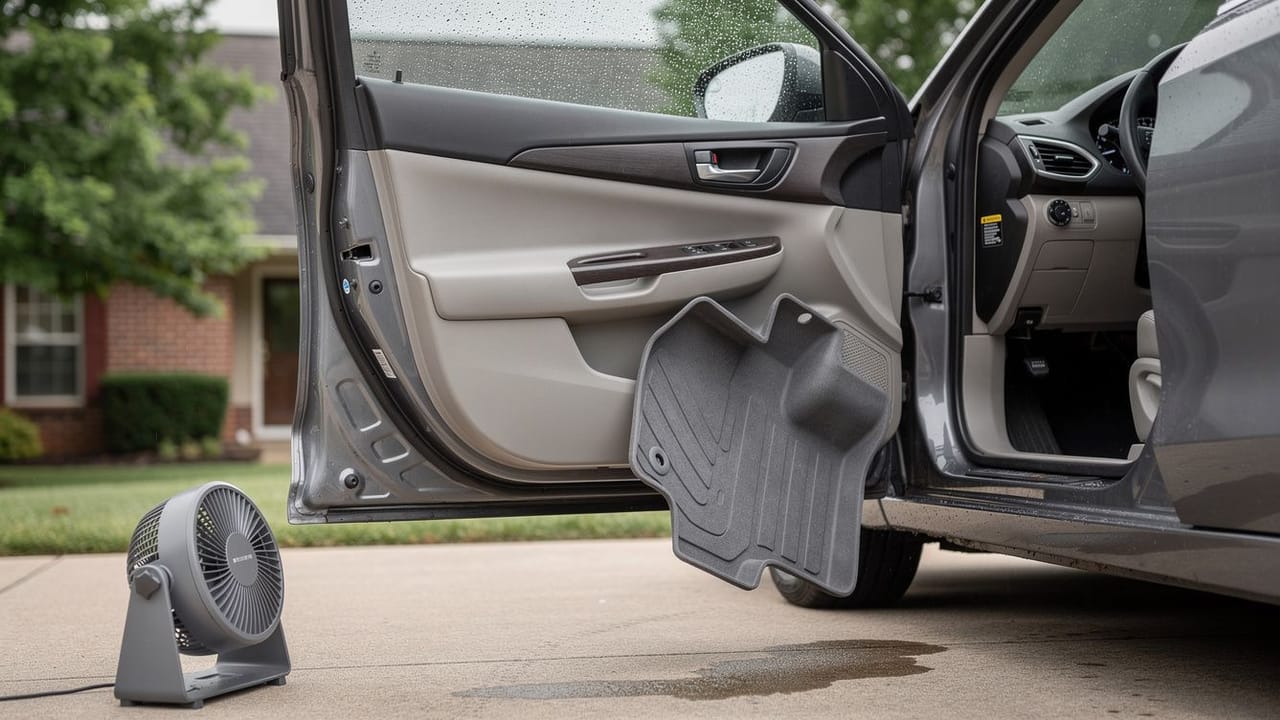
We use extraction, which pulls the water back out of the carpet as it cleans, so less of it is left sitting in the padding. Then the carpet has to dry all the way through. The EPA’s advice for a damp house is to dry everything completely and to run fans, air conditioning or a dehumidifier as needed; in a car in a Nashville summer we do the same with airflow and time.
A carpet cleaned and then left damp in a closed car is a mold problem waiting to start. The EPA notes that the longer mold grows, the more damage it does, and its page on mold cleanup in the home says carpet that turns moldy may have to be thrown away.
Leather and plastics
We clean leather and then condition it, and we treat dashboard plastics with a UV protectant. Cloth, vinyl and synthetic leather each need something different, which our post on upholstery cleaning by fabric goes through seat by seat.
If your car smells musty now, ask us for a free quote and tell us where you have noticed damp. It saves time, because that is where we start.
Sources
- U.S. EPA, A Brief Guide to Mold, Moisture and Your Home — Written for buildings: dry wet materials within 24 to 48 hours; mold returns if the water problem is not fixed; dry completely with fans, air conditioning or dehumidifiers; the longer mold grows, the more damage
- U.S. EPA, Mold Cleanup in Your Home — Moldy carpet may have to be thrown away
- Rose, Simmons, Crow and Ahearn, Volatile organic compounds associated with microbial growth in automobile air conditioning systems, Current Microbiology (2000) — Moisture and materials in car air conditioning systems suit biofilm growth and odor; reducing retained moisture advised for remediation
- Dominance of Gas-Eating, Biofilm-Forming Methylobacterium Species in the Evaporator Cores of Automobile Air-Conditioning Systems, mSphere (2020) — Condensation on the evaporator core as it cools the air supplies the water for microbial growth
FAQ
Interior Detailing in a Humid Climate — questions
Why does my car smell musty?
In the cars we see, it comes down to moisture: damp carpet from a leak, a door or trunk seal letting water in, a blocked air conditioning drain, or growth on the evaporator, where water condenses as the system cools the air. Cleaning the carpet without finding the source usually means the smell returns. If it gets worse when the AC runs, the evaporator is worth looking at.
Can carpet shampooing make it worse?
It can, if the water is not pulled back out. Moisture left in the padding under the carpet, in a car that stays closed through a humid stretch, gives mold the damp it needs. The EPA’s guidance for homes is to dry wet materials within 24 to 48 hours, which is why we extract the water as we clean and then dry the carpet completely.
How often should a car interior be detailed?
There is no set standard. It depends on how the car is used, who rides in it, and whether anything has been spilled or has leaked. The habit that matters more in our climate is dealing with moisture quickly, because a wet footwell left through a humid week becomes a much larger job than it needed to be.
How do you get rid of mold in a car?
Stop the water first, whether it is a leak, a failed seal, a blocked air conditioning drain or a clogged sunroof drain, or the mold comes back. Then extract the carpet and fabric and dry them completely with airflow and time. The EPA notes that carpet which turns moldy may have to be thrown away.